




Counselling in Singapore: Costs, Types of Therapy & How to Choose Support
Singapore
You may be considering counselling because something has changed. Work feels harder to switch off from. A relationship has become strained. You keep replaying conversations, losing sleep or feeling overwhelmed by decisions that once seemed manageable.
You might also be unsure what is wrong. You are getting through the day, but it takes more effort than other people realise.
Counselling offers professional support for understanding these experiences and working through them. You do not need a diagnosis or a neatly organised explanation before making an appointment.
This guide explains what counselling involves, how to compare costs in Singapore, the approaches you may encounter and how to choose suitable support.
What Is Counselling?
Counselling is a professional process in which you work with a trained practitioner to explore emotional difficulties, personal concerns and patterns affecting your life.
Listening is an important part of that process. A counsellor also brings therapeutic knowledge and skills to help you understand what is happening, consider different perspectives and identify useful ways forward.
Depending on your needs, sessions may involve:
- Processing a difficult experience or loss.
- Understanding recurring thoughts, emotions and reactions.
- Learning ways to respond to anxiety, stress or anger.
- Exploring relationships, expectations and personal boundaries.
- Making sense of uncertainty or a major life change.
- Practising changes that support your everyday wellbeing.
Some people want practical strategies for a particular difficulty. Others need time to speak openly, understand their feelings or process something painful. Your counsellor should work with you to establish what would be useful, rather than assume that everyone needs the same kind of session.
How Are Counselling and Psychotherapy Related?
Counselling and psychotherapy overlap considerably. Both can involve emotional support, psychological understanding and therapeutic work on patterns that affect daily life.
Practitioners may use the terms differently depending on their training and approach. Counselling is not necessarily brief or limited to everyday problems, and psychotherapy is not reserved for people with a diagnosis.
When choosing support, ask what the practitioner is trained to do and how they would approach your concern. That is more informative than relying on the service label alone.
When Might Counselling Be Helpful?
Counselling may be worth considering when a difficulty keeps returning, affects your relationships or daily functioning, or feels hard to work through on your own.
For example, you might notice that:
- Worry continues long after a situation has passed.
- You feel exhausted but guilty whenever you rest.
- Small disagreements lead to reactions you later regret.
- You are withdrawing from people or activities that matter to you.
- A loss or life change is difficult to make sense of.
- You repeatedly agree to things you do not have the capacity to take on.
- You want to make a decision but feel caught between competing expectations.
These experiences do not automatically indicate a mental health condition. They can still deserve attention.
In Singapore, work demands, caregiving responsibilities, financial pressures and family expectations can overlap. Counselling provides space to consider both your emotional responses and the circumstances contributing to them.
For instance, someone who feels anxious about work may need help understanding a fear of disappointing others. They may also need to consider an unrealistic workload. Useful counselling takes both into account.
How Much Does Counselling Cost in Singapore?
Counselling fees vary between providers. Differences can reflect session length, practitioner training and experience, the setting, and whether financial assistance is available.
You may find support through private counselling centres, social service agencies, educational institutions or a workplace Employee Assistance Programme. Eligibility, appointment availability and funding arrangements differ, so check directly with the provider.
If affordability is a concern, the Ministry of Health’s mental health services guide is a useful starting point for exploring community support.
Counselling Fees at The Lion Mind
For sessions with Mr James Chong, our published fees are:
| Session format | Fee | Duration |
|---|---|---|
| In-person counselling | SGD$200 | Up to 50 minutes |
| Online counselling | SGD$250 | Up to 50 minutes |
We do not sell therapy packages or pressure clients to purchase additional sessions. You can discuss whether and how you would like to continue.
Please check our current counselling information when booking, as fees and service arrangements may change.
What Should You Compare Besides the Session Fee?
Ask about the full arrangements before committing:
- How long is each session?
- Are there additional charges for reports, letters or other services?
- What are the cancellation and rescheduling terms?
- Is any employer or insurance coverage available, and what does it require?
- How will you discuss session frequency and review progress?
A sustainable budget matters. Let your counsellor know if cost affects how often you can attend, so you can discuss a realistic plan or other support options.
For a more detailed discussion, read our guide to how much counselling costs in Singapore.
What Types of Therapy Might You Encounter?
Counsellors and psychotherapists use different approaches. Some work mainly within one approach, while others integrate methods according to their training and the client’s needs.
You do not need to choose a therapy method by yourself before your first appointment. A practitioner should be able to explain what they recommend and why it may suit your situation.
Cognitive Behaviour Therapy
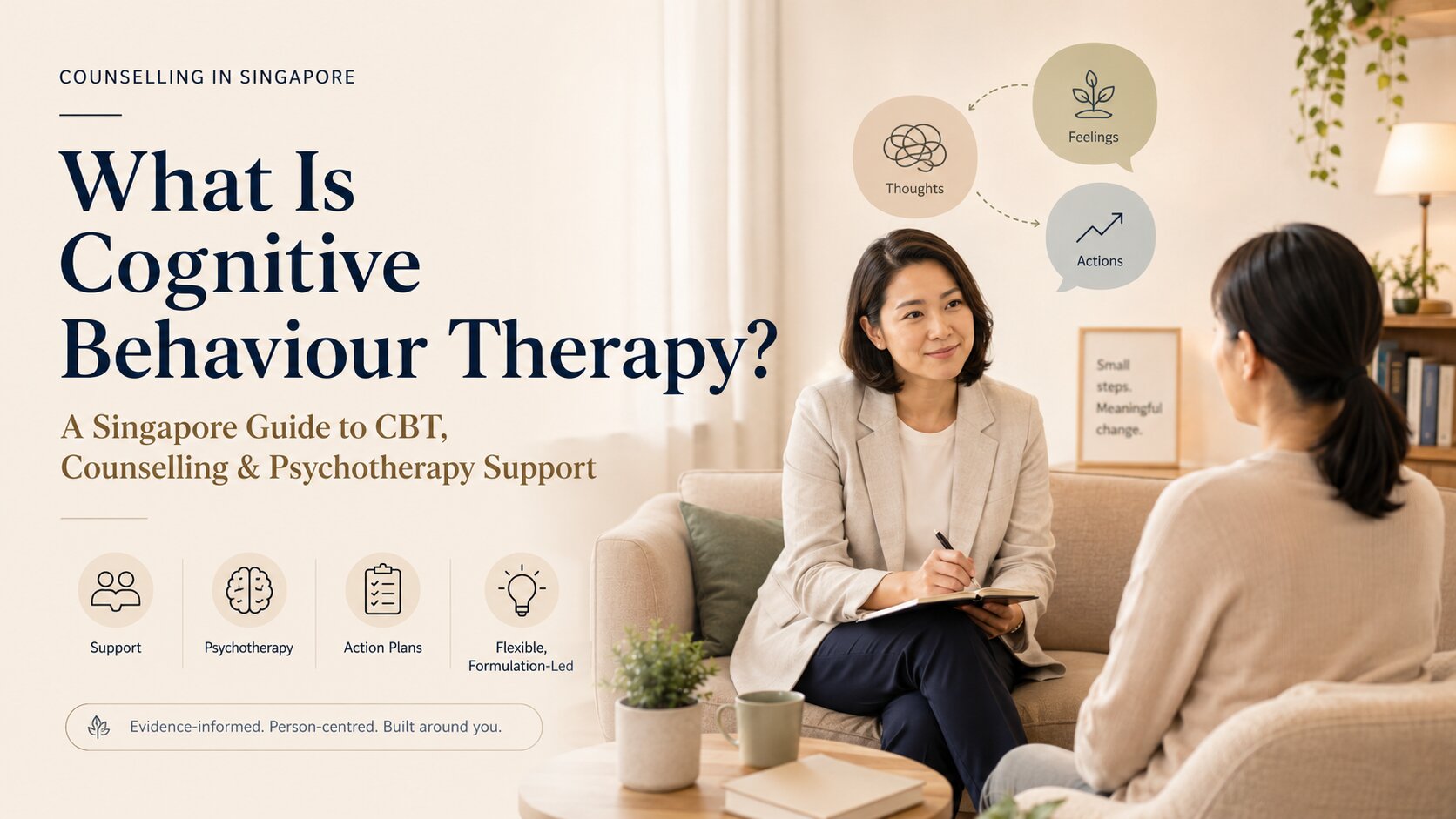
Cognitive Behaviour Therapy, or CBT, explores how situations, thoughts, emotions, physical sensations and behaviours interact.
Imagine that you make a mistake at work and think, “Everyone will see that I am incapable.” You may then repeatedly check your work, avoid asking questions and stay late to compensate. These responses can increase exhaustion and keep the fear going.
CBT can help you examine that pattern and explore different responses. This might involve reviewing an interpretation, testing an assumption or trying a manageable change in your behaviour.
CBT should be adapted to the person and the concern. The National Institute of Mental Health’s psychotherapy overview describes how therapeutic approaches can help people work with distressing thoughts, emotions and behaviours.
At The Lion Mind, we emphasise understanding the individual and developing a formulation: a working explanation of the difficulty, what contributes to it and what may help. This guides how CBT is used.
Read more about Cognitive Behaviour Therapy at The Lion Mind.
Person-centred Approaches
Person-centred approaches place your lived experience, needs and perspective at the centre of counselling. Your counsellor works to understand what matters to you and involves you in decisions about the focus and pace of sessions.
This way of working can guide the wider counselling relationship, including when structured approaches such as CBT are used. Your counsellor brings professional knowledge and therapeutic skills while remaining responsive to your circumstances, preferences and feedback.
For example, you may need time to process a painful experience before considering practical changes. At another point, you may want help identifying a manageable next step. A person-centred approach makes room for these changing needs.
Solution-Focused Brief Therapy
Solution-Focused Brief Therapy explores what you would like to be different, the resources available to you and the small changes that could help.
A counsellor might ask when a problem has been less difficult, what helped on that occasion or what a manageable improvement would look like.
The emphasis is on developing useful next steps. The word “brief” does not mean that everyone should improve within a fixed number of sessions.
Integrative and Experiential Approaches
An integrative practitioner may draw from more than one therapeutic approach while maintaining a clear understanding of your needs.
Some sessions may also involve imagery, creative reflection or other experiential exercises. These should have an explained purpose, be appropriate to your situation and remain a choice you can discuss or decline.
The presence of a particular tool does not, by itself, establish the quality of therapy. What matters is the practitioner’s competence, the reason for using it and how it fits the work you are doing together.
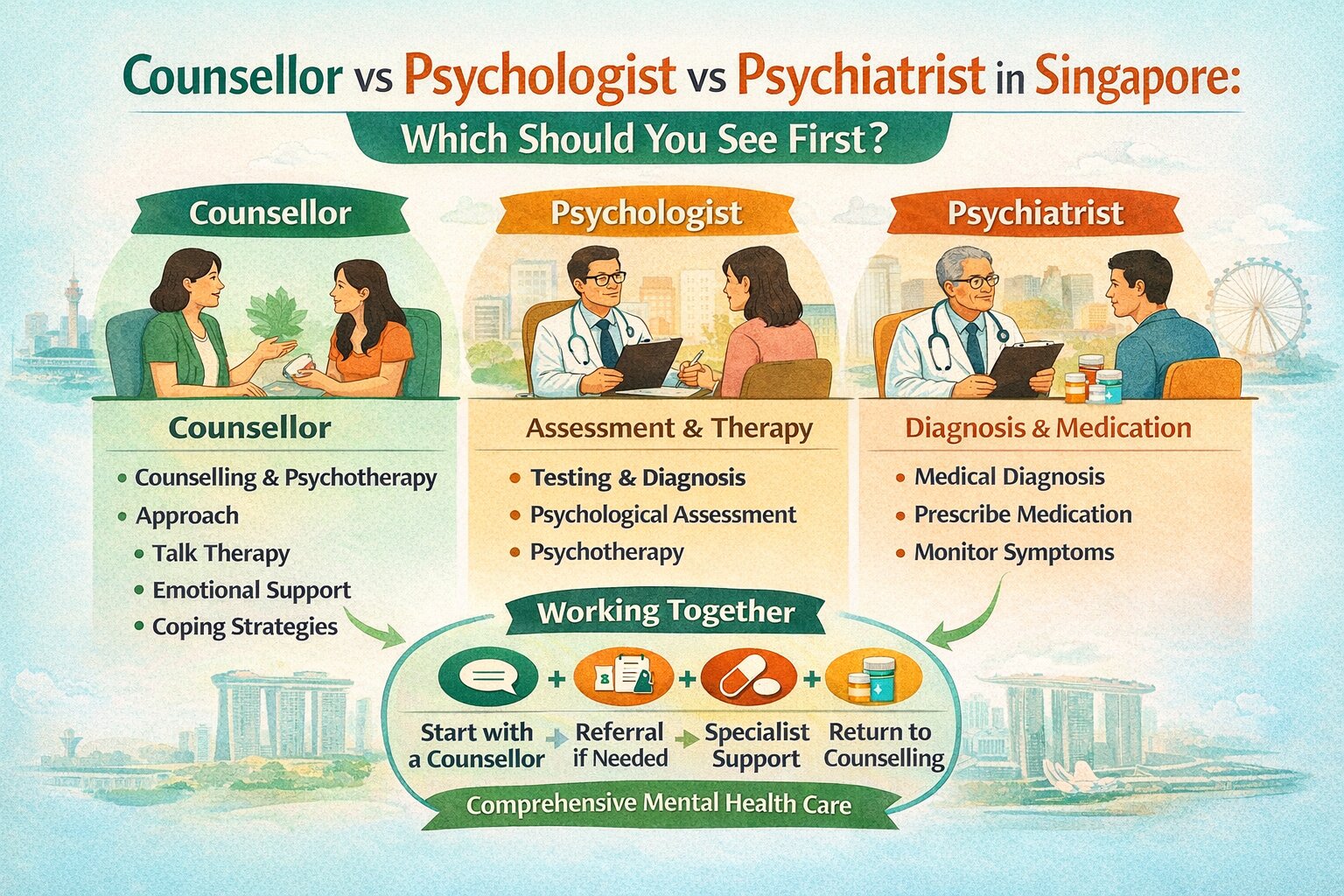
Should You See a Counsellor, Psychologist or Psychiatrist?
If you are looking for counselling or psychotherapy, a suitably trained counsellor is a good place to start. You can approach a counsellor directly for support with emotional distress, relationship difficulties, grief, stress, burnout or patterns you want to understand and change.
You do not need a diagnosis or a referral before seeking counselling. You can begin by explaining what has been happening and discussing the support that may suit your needs.
Counsellors bring professional therapeutic skills to this work. Depending on their training, sessions may involve understanding your difficulties, developing a shared formulation, processing emotions, practising coping strategies and reviewing changes in your daily life.
The main consideration is the practitioner’s relevant training, experience and competence.
| Professional | When their support may be useful |
|---|---|
| Counsellor or psychotherapist
|
A direct starting point when you want counselling or psychotherapy to work through emotional difficulties, relationships, life changes or recurring psychological patterns. Choose someone with relevant therapeutic training and experience.
|
| Clinical or counselling psychologist
|
An option for psychological therapy, or when you need a particular psychological assessment, testing service or area of expertise that the practitioner provides.
|
| Psychiatrist
|
Appropriate when you need specialist medical assessment, medication advice or management of a psychiatric condition. Psychiatrists are medical doctors, and some also provide psychotherapy.
|
Starting with a Counsellor
You do not have to work out every aspect of your support needs before making an appointment. A counsellor can help you understand your concerns, discuss a suitable therapeutic approach and recognise when additional care may be useful.
Starting with counselling also leaves room for collaboration. If medical assessment, psychological testing or specialist treatment would be appropriate, your counsellor can discuss a referral with you. Counselling may continue alongside that care.
Seek medical assessment directly when symptoms may have a physical cause, you need medication advice, or you are experiencing significant changes in your mental state or ability to function. A GP can provide an initial medical assessment. Immediate safety concerns require urgent support.
For readers seeking a professional space to understand their experiences and work towards change, booking a counselling session is a practical first step.
How Do You Choose a Counsellor in Singapore?
A useful choice combines professional suitability with a working relationship in which you feel respected and able to participate.
1. Check Relevant Training and Experience
Look for counselling or psychotherapy training and experience relevant to your concern. You can ask:
- What training have you completed for this work?
- Have you supported people with concerns similar to mine?
- How do supervision and ongoing professional development inform your practice?
- When would you recommend another practitioner or additional care?
If a counsellor states that they are professionally registered, check the relevant register. The Singapore Association for Counselling provides information about its membership and finding Registered Counsellors.
Association membership and Registered Counsellor status should not be assumed to mean the same thing.
2. Ask How the Counsellor Works
You might prefer practical exercises, reflective conversation or a combination of both.
Ask how the counsellor would begin understanding your concern, how you would agree on the focus of sessions and how progress would be reviewed. You should be able to ask questions without feeling that you are challenging their authority.
3. Notice How Your Concerns Are Received
A first session can feel unfamiliar or emotional. You do not have to feel completely comfortable immediately.
However, you should have room to explain your perspective, ask for clarification and say when something does not fit. A productive therapeutic relationship can include disagreement and feedback.
If you feel persistently dismissed, pressured or unable to raise concerns, discuss this where possible and consider whether another practitioner may suit you better.
4. Consider Practical Fit
Fees, appointment times, language, location and accessibility all affect whether you can use the service comfortably.
For more detail, see how to choose a counsellor in Singapore.
Online or In-Person Counselling?
Consider which format allows you to speak privately, attend reliably and engage with the session.
In-person counselling may suit you if you want a space away from home or work, prefer being in the same room as your counsellor, or find it difficult to speak without interruptions where you live.
Online counselling may reduce travel demands and help maintain continuity when attending physically is difficult. You will need a suitable device, a reliable connection and a private place to speak.
Your needs and the practitioner’s assessment also matter. Discuss whether the format is suitable, how interruptions would be handled and what support arrangements apply.
If you will be outside Singapore during a session, check with the provider beforehand. Availability can depend on your location and the practitioner’s service arrangements.
The Lion Mind offers both in-person and online sessions. Contact us to discuss the available options.
What Happens During the First Session?
The first session usually focuses on understanding what brought you to counselling and what you hope to gain.
Your counsellor may ask about your current difficulties, how they affect your life, relevant background and what you have already tried. They may also ask about safety and existing support.
You can begin with something as simple as, “I have been feeling overwhelmed, and I am not sure why.”
You do not need to disclose every painful experience immediately. You can say that a topic feels difficult or that you would like to approach it more gradually.
The session is also an opportunity to ask about the approach, confidentiality, fees and next steps. Read our first counselling session guide for a fuller walkthrough.
Is Counselling Confidential?
Confidentiality is central to counselling, but it has limits.
Before you begin, the practitioner should explain how information is handled and the circumstances in which disclosure may be necessary, such as serious safety concerns or legal requirements.
You can also ask how records are stored, whether cases are discussed in professional supervision and what information might be shared with an employer, insurer or referring organisation.
If you are arranging counselling for a young person, clarify how confidentiality and parental involvement will work before sessions begin.
How Many Sessions Will You Need?
The number of sessions depends on your concern, circumstances, goals and how the work develops.
Some people seek focused support around a particular decision or event. Others want time to work through longstanding difficulties. Your budget, availability and other sources of support also matter.
Discuss an initial plan and review it together. Useful questions include:
- What are we focusing on at the moment?
- What changes have I noticed in daily life?
- What still feels difficult?
- Is the approach helping, or should we adjust it?
- Would additional or different support be useful?
Progress can include feeling more able to discuss a painful experience, responding differently in a difficult moment or making a decision you have been avoiding. If sessions do not seem useful, that deserves an open conversation.
When You Need Immediate Support
If you may act on thoughts of harming yourself or someone else, or you cannot stay safe, seek immediate emergency assistance or go to the nearest hospital emergency department. Do not wait for a routine counselling appointment.
For suicide-related distress or crisis support, Samaritans of Singapore provides a 24-hour hotline at 1767.
Starting Counselling at The Lion Mind
At The Lion Mind, we provide counselling and psychotherapy within a psychology-grounded, person-centred practice.
We work with individuals experiencing emotional distress, anxiety, low mood, stress, burnout, grief, relationship difficulties and recurring life patterns. Sessions may involve emotional support, reflection, practical therapeutic work or a combination suited to your needs.
Your first appointment is an opportunity to explain what has been happening, ask questions and discuss a suitable direction. Where your needs extend beyond our scope, we can discuss appropriate additional support or referral.
Book a counselling appointment with The Lion Mind.
Related articles
Counsellor vs Psychologist vs Psychiatrist in Singapore: Which Should You See?
If you like what you read, follow us on Facebook, Instagram, LinkedIn, or Tik Tok to get the latest updates.
Have a question? Reach out to us through our contact form or WhatsApp.
Want to speak to our clinicians? Book your appointment here!