


 0
0

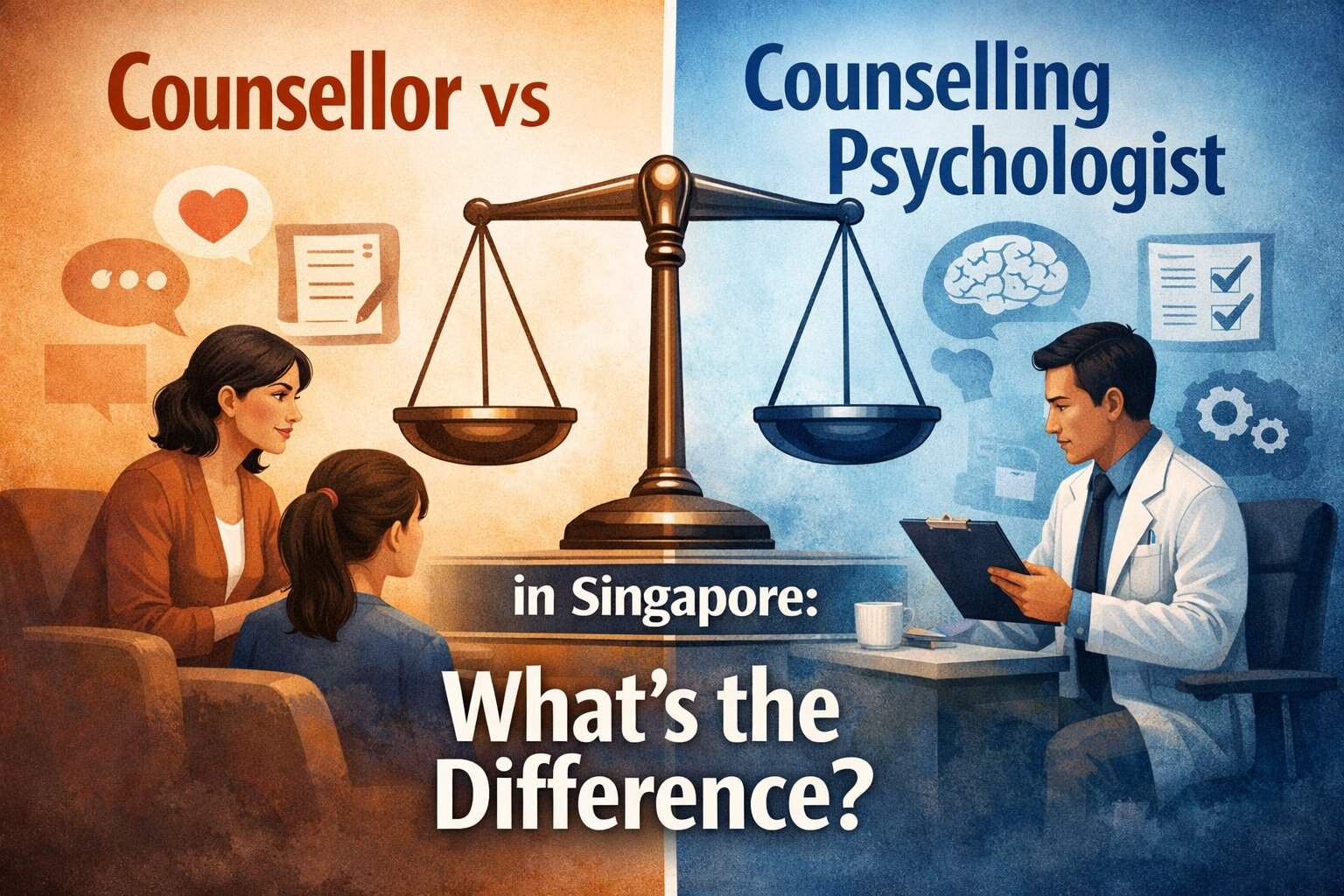
Counsellor vs Counselling Psychologist in Singapore: What’s the Difference?
Singapore
Mar 18 2026
When people look for mental health support in Singapore, they may come across both counsellors and counselling psychologists. To the public, the two can appear very similar. Both may provide therapy, support people through emotional distress, and help clients work through difficulties in life, relationships, work, and mental wellbeing.
At the same time, they are not exactly the same profession.
At The Lion Mind, we find that the difference is often best understood in terms of training pathway, professional identity, and practice emphasis, rather than the mistaken idea that one provides “real psychology” while the other only provides “supportive listening”.
Quick answer
A counsellor is trained within the counselling profession to provide counselling and therapeutic support for emotional, behavioural, relational, and adjustment-related concerns.
A counselling psychologist is trained within psychology as a discipline, with a counselling psychology orientation.
In actual practice, there can be substantial overlap between the two. Both may support clients dealing with anxiety, depression, grief, trauma, burnout, identity concerns, and life transitions. The clearer distinction is usually not whether both can do therapy, but how they are trained and the professional framework they come from.
What does a counsellor do?
A counsellor provides counselling and therapeutic support to help clients better understand themselves, manage distress, build coping skills, process difficult experiences, and work towards meaningful change.
In practice, counsellors may help with concerns such as:
-
anxiety and excessive worry
-
depression and low mood
-
stress and burnout
-
anger management
-
grief and loss
-
trauma
-
self-esteem and identity issues
-
adjustment difficulties
-
relationship or interpersonal struggles
Counselling is not simply about listening. It may involve case formulation, therapeutic relationship-building, emotional processing, reflection, skills development, and structured interventions tailored to the client’s goals.
It is also worth noting that not all counsellors come through the same academic route. Some counsellors hold undergraduate degrees in psychology before pursuing counselling training, while others enter from related disciplines before completing their professional counselling preparation.
What does a counselling psychologist do?
A counselling psychologist also works therapeutically with people facing emotional distress, crisis, life challenges, and difficulties in functioning.
Like counsellors, counselling psychologists may provide talking therapy and psychological support. However, their training is grounded within psychology as a discipline, rather than within counselling as a standalone profession.
So while counselling psychologists may provide therapy in ways that look similar to counsellors from a client’s point of view, their professional formation is usually more explicitly rooted in psychology.
The real difference is training pathway, not whether therapy is “psychological”
At The Lion Mind, we find that public confusion often comes from the assumption that counsellors are less psychologically informed than counselling psychologists. That is not necessarily true.
Many counsellors work with case formulation, evidence-based approaches, and psychologically informed therapy. Some also have an undergraduate degree in psychology before completing their counselling training. What differs is that counselling as a profession does not always require a psychology-major entry pathway, whereas counselling psychology is rooted more directly in psychology as a discipline.
A more balanced way to understand the distinction is this:
-
Counsellors are trained within the counselling profession, though some also have psychology training.
-
Counselling psychologists are trained within psychology, and then specialise in counselling psychology.
That means the difference is not that one provides “psychological” therapy while the other does not. The better distinction is that the two professions emerge from different training traditions and professional identities.
Is counselling psychology more assessment-focused?
In broad terms, counselling psychology training may place relatively greater emphasis on psychological assessment, psychological testing, diagnosis-related understanding, and research than many members of the public assume.
By contrast, the counselling pathway is often more directly centred on counselling practice itself.
At The Lion Mind, we believe raw practicum hour counts do not always tell the full story. What matters is how those hours are actually spent. A larger total number of practicum hours does not automatically mean more intensive counselling-specific training.
In the counselling pathway, training is often highly concentrated on counselling work itself. Counsellors typically complete 100 practicum hours during their master’s training, focused on counselling, followed by an additional 600 hours after graduation. In practical terms, this can amount to 700 counselling-specific hours.
In the counselling psychology pathway, practicum training may involve a broader spread of activities such as counselling, assessment, testing, diagnosis-related work, supervision, case documentation, case conference, and other clinical processes. Although the total practicum hours may be higher overall, not all of these hours are purely counselling hours.
For this reason, comparing counsellors and counselling psychologists based only on total practicum hours can be misleading. A more meaningful comparison is the proportion of training focused specifically on counselling practice.
A balanced way to understand the difference is this: counselling psychologists may receive broader psychology-based and assessment-oriented training, while counsellors may in some cases undergo more concentrated training in counselling itself.
Are counselling psychologists the same as clinical psychologists?
No. They are different specialisations, even though there can be overlap.
In broad terms, clinical psychology has traditionally been associated with more moderate to severe presentations, psychometric testing, formal assessment, and higher-acuity clinical work.
Counselling psychology, by contrast, is commonly understood as focusing more on wellbeing, distress, crisis, problem-solving, and decision-making.
So the difference between counselling psychology and clinical psychology is better understood as one of traditional emphasis, not a strict rule that one belongs only in hospitals and the other only in the community.
Why people get confused
There are a few reasons this distinction is often unclear.
First, both counsellors and counselling psychologists may work with very similar presenting concerns. From the client’s point of view, both may offer therapy for anxiety, depression, grief, trauma, stress, and personal difficulties.
Second, the title psychologist often carries more public recognition, even though this does not automatically mean that all therapy provided under a psychology title is fundamentally different from counselling.
Third, counselling psychologists may receive more assessment-oriented and psychology-based training than many people realise, while counsellors may be more psychologically informed than many people assume. That makes the boundary less obvious from the outside.
Which one should you see?
The better question is usually not “Which one is higher?” but:
What kind of support do you need?
A counsellor may be suitable if you are looking for:
-
therapeutic support for emotional distress, life difficulties, or relational struggles
-
a space to process experiences and build coping strategies
-
support with patterns in thinking, feeling, relating, and functioning
A counselling psychologist may be suitable if you are looking for:
-
a psychologist-trained practitioner
-
support from someone whose pathway is rooted in psychology
-
a practitioner whose training may place greater emphasis on assessment and psychology-based frameworks
In many cases, the more important question is not the title alone, but the practitioner’s actual training, supervised experience, therapeutic approach, and fit for your needs.
A more balanced way to understand the difference
At The Lion Mind, we believe it is more accurate to see counsellors and counselling psychologists as different professional pathways with overlapping areas of practice, rather than as a simple hierarchy.
A counsellor is not merely a “lighter” version of a counselling psychologist.
A counselling psychologist is not simply a counsellor with a more impressive title.
They are distinct professional identities with different entry routes and training traditions, even though both may engage in meaningful therapeutic work.
Final thoughts
If you have been wondering about the difference between a counsellor and a counselling psychologist in Singapore, the most balanced answer is this:
-
both may provide therapy
-
both may support people through distress and life difficulties
-
both may help clients move towards insight, coping, and change
-
the key difference is usually their training pathway and professional orientation
Counsellors are trained within the counselling profession, though some also have psychology training. Counselling psychologists are trained within psychology and then specialise in counselling psychology.
Just as importantly, higher total practicum hours do not always mean more counselling-specific training. In some cases, the counselling pathway may involve more concentrated experience in counselling work itself, while the counselling psychology pathway may spread training across counselling, assessment, testing, diagnosis-related work, and other clinical functions.
For many clients, the best choice is not about selecting the most impressive-sounding title, but about finding the right fit for their needs.
To book a counselling session with The Lion Mind mental health clinician, visit https://www.thelionmind.com.sg/book-an-appointment
Related articles
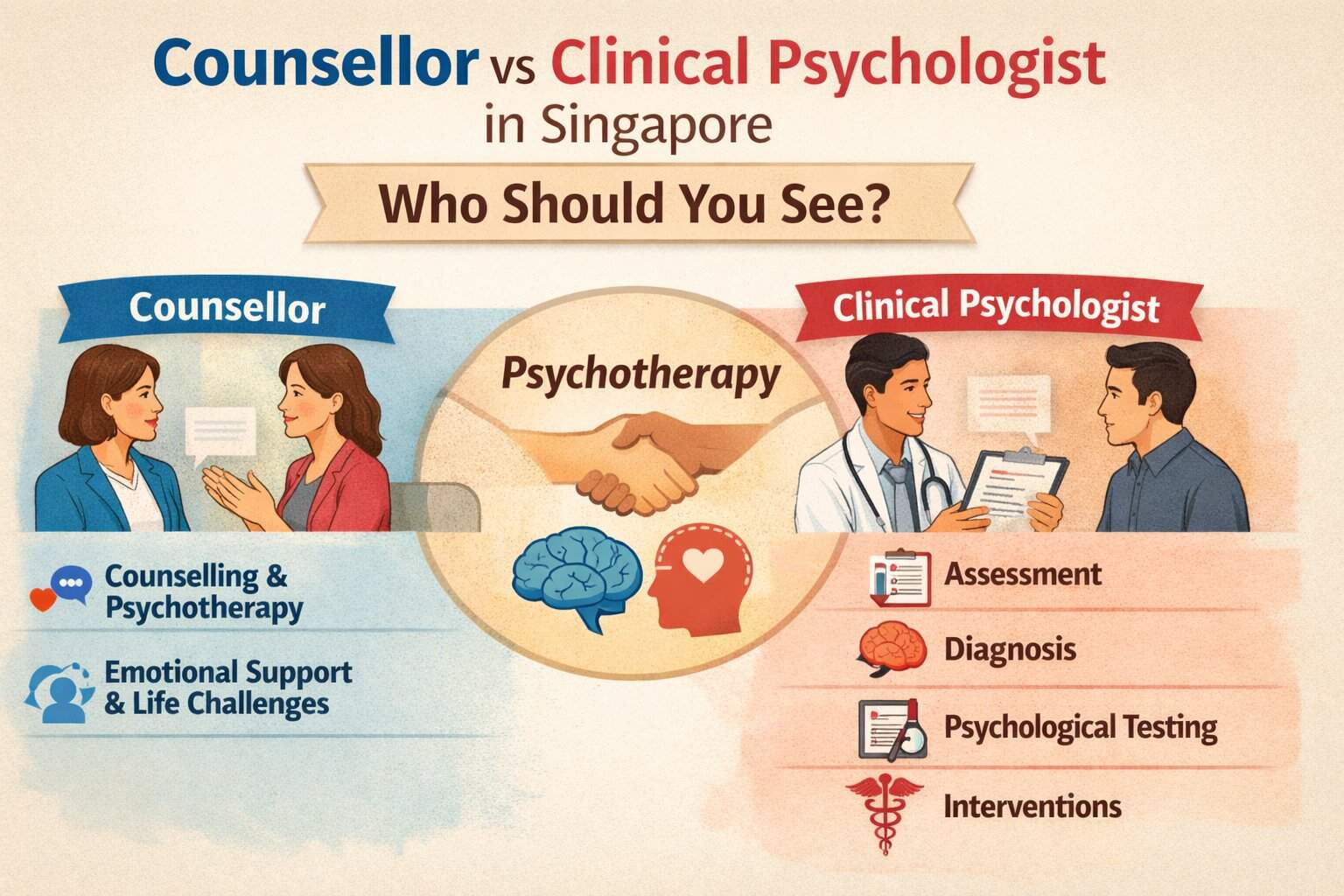
Counsellor vs Clinical Psychologist in Singapore: Who Should You See?

What is Cognitive Behaviour Therapy
If you like what you read, follow us on Facebook, Instagram, LinkedIn, or Tik Tok to get the latest updates.
Have a question? Reach out to us through our contact form or WhatsApp.
Want to speak to our clinicians? Book your appointment here!

Join Our Newsletter
Subscribe to our newsletter and receive daily updates & promotions!