



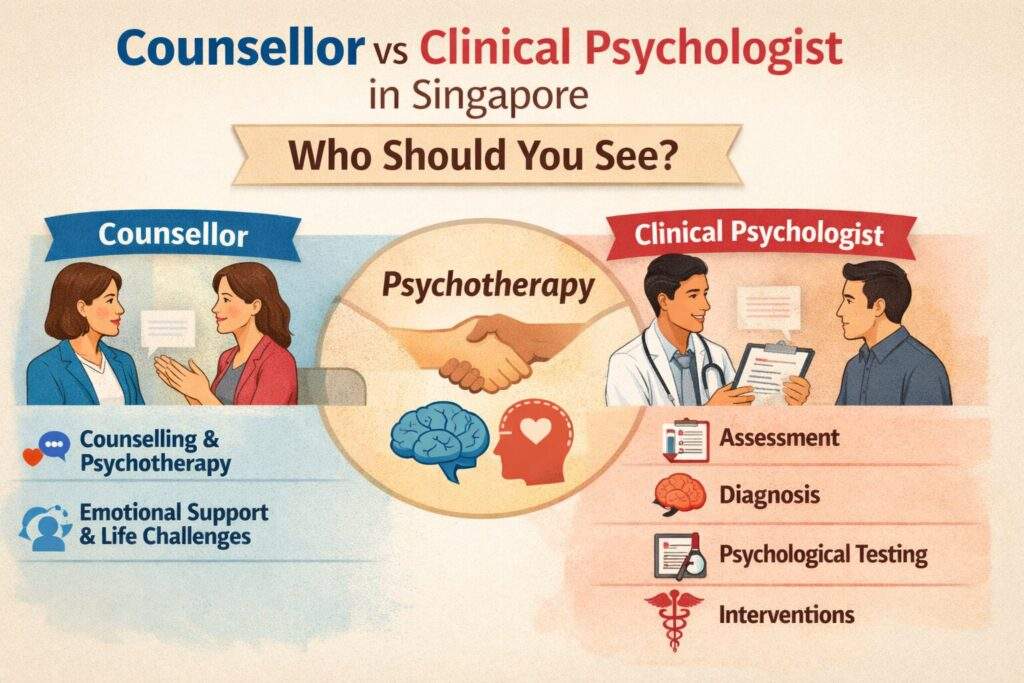
Counsellor vs Clinical Psychologist in Singapore: Who Should You See?
Singapore
Counsellor or Clinical Psychologist: Who Should You See?
If your primary need is counselling or psychotherapy, a professionally trained counsellor is usually the most direct professional to consider.
Counselling is the counsellor's core professional discipline. Their professional education, supervised practice and subsequent clinical experience are centred strongly on helping people through counselling and psychotherapy.
Clinical Psychologists can also provide psychotherapy. However, clinical psychology training serves several professional functions. It includes psychological intervention alongside psychological assessment, testing, research and other areas of applied psychology.
The distinction is therefore not that one profession provides a higher level of therapy than the other. Their professional training places emphasis in different areas.
If the service you are actually looking for is counselling, counselling-specific training and direct therapeutic experience deserve considerable weight.
If you specifically require formal psychological assessment, testing or a psychologist-specific report, a Clinical Psychologist with current competence in that particular service may be more appropriate.
What Does a Professional Counsellor Do?
A professional counsellor provides psycho-emotional support through counselling and psychotherapy.
People seek counselling for many reasons, including anxiety, low mood, stress, burnout, grief, relationship difficulties, emotional regulation, career concerns, difficult life transitions and recurring emotional or behavioural patterns.
You do not need to have a diagnosed mental health condition before seeking counselling.
Counselling may help you process difficult experiences, understand emotions, recognise patterns, explore different perspectives, develop coping strategies and work towards meaningful change.
Professional counselling is also more than simply having someone listen to you.
Depending on the counsellor's approach and training, therapeutic work may involve intake assessment, case formulation, psychological education, structured reflection, therapeutic exercises, professional observations, practical suggestions and changes to patterns of behaviour.
Some counsellors work in a highly structured and practical way. Others place greater emphasis on emotional processing or the therapeutic relationship. Many integrate different approaches according to the client's needs.
Counselling is therefore a professional therapeutic discipline in its own right.
What Does SAC Registered Counsellor Status Mean?
The Singapore Association for Counselling, or SAC, maintains the professional Register of Counsellors in Singapore.
SAC-recognised postgraduate counselling programmes are designed specifically to prepare people for professional counselling practice.
These programmes require at least 100 hours of counselling practicum and 10 hours of clinical supervision.
After graduation, an individual must complete at least another 600 postgraduate clinical hours and 60 hours of clinical supervision before qualifying to apply for Registered Counsellor status.
The practicum completed during professional training is separate from those subsequent postgraduate clinical hours.
This creates a professional pathway that places substantial emphasis on learning counselling, practising counselling and accumulating direct clinical experience.
For someone seeking counselling or psychotherapy, that matters.
Rather than viewing a Registered Counsellor as a more general mental health professional, it is more accurate to recognise that counselling is what the professional pathway is specifically designed to develop.
Do Counsellors Need a First Degree in Psychology?
No.
Counsellors may enter postgraduate counselling training from many different academic backgrounds.
Someone may previously have studied education, engineering, business, healthcare, social sciences or another discipline before undertaking professional counselling education.
Professional counselling training, supervised practice and subsequent clinical experience are what prepare the person for counselling work.
However, an undergraduate psychology education can provide an additional academic foundation.
A psychology degree typically includes education in psychological theories, human behaviour, cognition, emotion, development, mental health, research methodology and the evaluation of psychological evidence.
This is why The Lion Mind has deliberately chosen to combine psychology education with professional counselling training.
Why Do The Lion Mind's Counsellors Have Psychology Degrees?
The Lion Mind uses a psychology-grounded counselling model.
Its client-facing clinicians have an undergraduate psychology foundation together with the professional training appropriate to their respective roles.
For The Lion Mind's counsellors, this means professional counselling training is supported by formal education in psychological theories, human behaviour, research methods and evidence appraisal.
The psychology foundation helps clinicians critically examine psychological concepts, interventions and assessment tools rather than accepting them simply because they are popular or described as psychological.
For example, a framework such as the Myers-Briggs Type Indicator, or MBTI, may be useful for reflection, career conversations or discussing preferences.
A psychology-grounded clinician should nevertheless be able to consider the evidence behind the tool, recognise its limitations and avoid treating it as equivalent to a formal clinical psychological assessment.
Professional counselling education then develops the therapeutic competencies required to work directly with clients.
The result is a combination of psychological knowledge and counselling expertise.
This does not mean counsellors without psychology degrees cannot be competent practitioners. It means The Lion Mind has deliberately chosen to add a formal psychological-science foundation to its counselling model.
What Does a Clinical Psychologist Do?
A Clinical Psychologist completes postgraduate applied psychology training in clinical psychology.
Their education includes psychological intervention alongside areas such as psychological assessment, testing, research, ethics and supervised professional practice.
Some Clinical Psychologists spend a large part of their professional practice providing psychotherapy.
Others divide their work between psychotherapy, psychological assessment, testing, research, consultation, teaching or other professional activities.
This matters because the title Clinical Psychologist does not by itself tell you how much counselling or psychotherapy the individual practitioner actually provides.
A Clinical Psychologist who spends most of their career providing therapy may become highly experienced in psychotherapy.
Likewise, a Registered Counsellor who spends most of their professional career providing counselling may accumulate extensive therapeutic experience.
For therapy itself, it therefore makes more sense to compare the clinicians' actual therapeutic preparation and experience rather than assuming expertise from title alone.
How Do Their Professional Training Pathways Differ?
The Registered Counsellor and Clinical Psychologist pathways are designed around different professional roles.
The counsellor pathway is particularly concentrated on counselling and psychotherapy.
Clinical psychology training distributes professional preparation across intervention together with assessment, testing, research and other psychology functions.
This is important when comparing practicum or training hours.
A headline total does not necessarily tell you how much of that training involved direct counselling or psychotherapy.
For someone seeking therapy, the useful question is not simply:
Who completed more total training hours?
A better question is:
How much of the clinician's education, supervision and professional experience has been devoted to the therapeutic work I am seeking?
The counsellor's professional pathway is deliberately built around that therapeutic work.
Does a Clinical Psychologist Automatically Have More Psychotherapy Expertise?
No.
A professional title does not automatically establish how experienced someone is in psychotherapy.
A Registered Counsellor may have completed postgraduate counselling education, substantial supervised clinical practice and many years of counselling as the central focus of their work.
A Clinical Psychologist may likewise develop significant psychotherapy expertise where therapy forms a substantial part of their practice.
Therapeutic competence develops through relevant education, supervision, continuing professional development and repeated direct clinical work.
Therefore, if you are choosing someone primarily for psychotherapy, it is reasonable to look closely at the individual's therapeutic training, clinical experience, areas of competence and approach to counselling.
The word psychologist should not be treated as shorthand for better counselling.
What If a Clinical Psychologist Mainly Provides Therapy?
There can be considerable overlap.
If a Clinical Psychologist mainly provides counselling or psychotherapy and does not routinely provide formal psychological testing, the service delivered in an ordinary therapy session may be substantially similar to the work of a professional counsellor.
Both may conduct an intake assessment.
Both may develop a case formulation.
Both may provide psychoeducation.
Both may work therapeutically with thoughts, emotions, behaviour, relationships and life experiences.
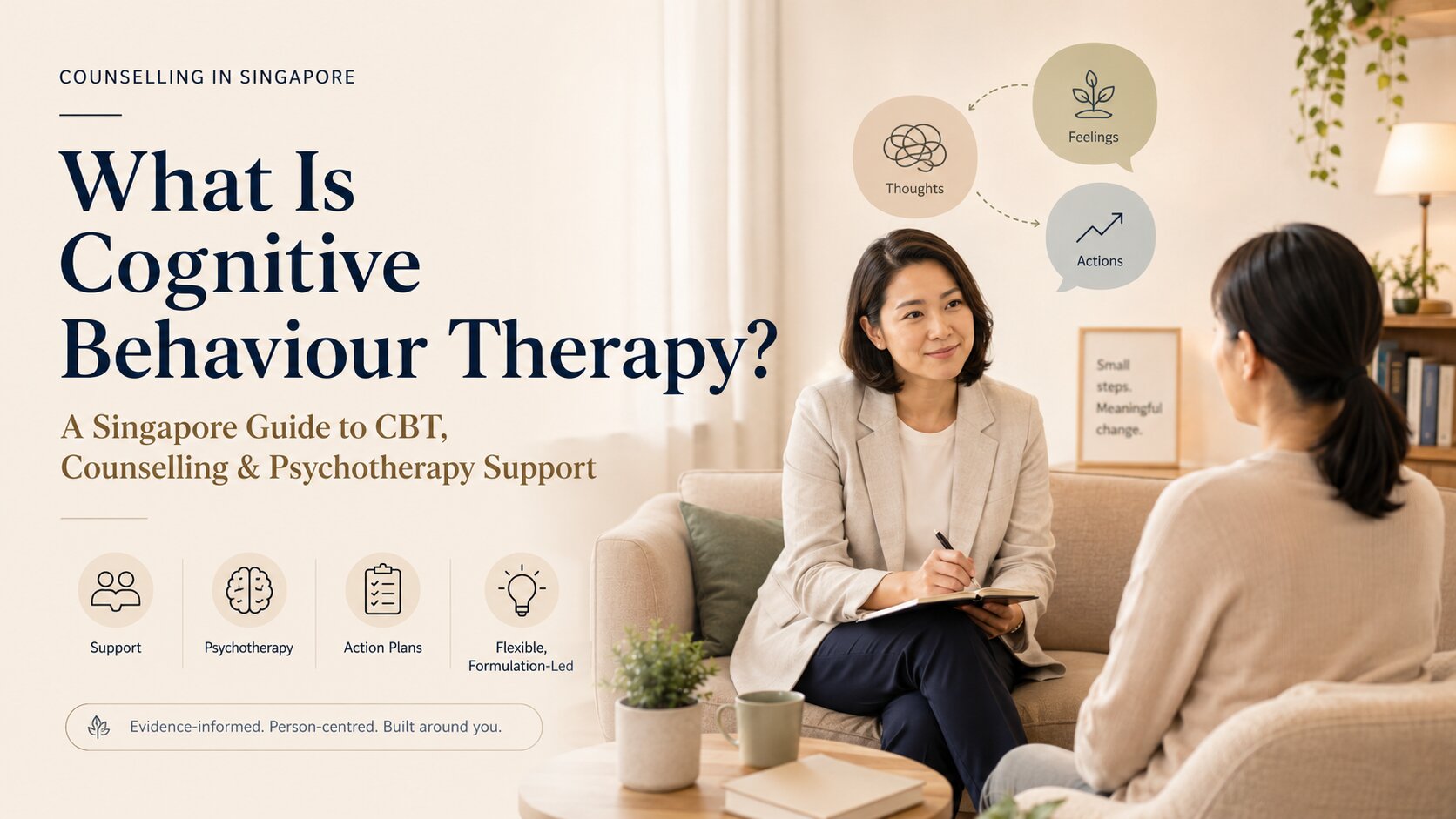
Both may use therapeutic approaches such as Cognitive Behaviour Therapy when appropriately trained.
In that situation, the practical question becomes less about whether the practitioner is called a counsellor or psychologist and more about who is the stronger therapist for your particular needs.
For a counsellor, however, counselling itself is the central professional discipline around which their training and clinical identity are built.
Counselling Assessment and Psychological Assessment Serve Different Purposes
Professional counsellors assess clients as part of responsible therapeutic work.
Counselling assessment may involve understanding the client's presenting concerns, emotional state, history, relationships, stressors, coping patterns, strengths, goals and safety concerns.
Counsellors may also use structured intake procedures, risk assessments, mental health screening questionnaires, wellbeing measures and progress measures.
This information supports case formulation and helps determine how counselling should proceed.
Formal psychological assessment serves a different purpose.
It may involve specialised psychological tests, standardised scoring, interpretation and formal reporting.
These are not simply higher and lower versions of the same activity.
They answer different professional questions.
If you are coming for counselling or psychotherapy, a counselling assessment may provide the information needed to begin therapeutic work.
If you require a specific formal psychological test or report, then a professional with current competence in that assessment should be sought.
When Might You Need a Clinical Psychologist?
A Clinical Psychologist may be particularly relevant when your needs include formal psychological assessment, psychological testing or another service that specifically requires those competencies.
For example, a school, medical professional, organisation or another service may request a formal psychological assessment or report.
Even then, you should check whether the individual Clinical Psychologist actually provides the particular assessment you require.
Different psychological tests require different training and experience.
Being a Clinical Psychologist does not automatically mean that someone currently provides every form of psychological assessment.
The service you require should therefore determine the professional you approach.
Do You Need a Clinical Psychologist Just Because You Have Anxiety or Depression?
No.
Experiencing anxiety, low mood or other psychological symptoms does not automatically mean that you need a Clinical Psychologist.
Professional counsellors work with emotional and psychological concerns as part of counselling and psychotherapy.
A counsellor may support clients experiencing anxiety, low mood, stress, burnout, grief, emotional difficulties, relationship concerns and other forms of psychological distress, provided these fall within the clinician's training and competence.
The presence of a mental health concern does not transform counselling into psychologist-only work.
Where another professional service becomes useful, that service can be added.
Formal psychological assessment may be sought when there is a specific assessment question.
Psychiatric input may be sought where diagnosis or medication needs to be considered.
Counselling can remain an important part of the client's care.
What About More Complex Mental Health Concerns?
Complexity should not be determined by professional title alone.
Counsellors differ in their training and experience, just as Clinical Psychologists do.
Some counsellors develop substantial expertise working with particular psychological concerns through postgraduate training, supervision, continuing professional education and years of clinical practice.
The important question is whether the individual practitioner has the competence, experience and professional support required for the client they are working with.
A responsible counsellor should also recognise when another professional service would be useful.
This might include psychiatric care, formal psychological assessment, medical treatment or another specialised service.
Referral does not mean counselling has failed or that the counsellor has become irrelevant.
It means different professionals can contribute different components of care.
What Happens at The Lion Mind If Diagnosis or Medication Is Needed?
The Lion Mind currently provides counselling and psychotherapy and does not presently have a Clinical Psychologist on its clinical team.
Its counsellors provide counselling assessment, mental health screening where appropriate, case formulation and therapeutic support.
If a counsellor believes that formal psychiatric diagnosis and/or medication may be useful, the client may be referred to a trusted psychiatrist.
Where appropriate, counselling can continue alongside psychiatric care.
The psychiatrist manages the medical, diagnostic and medication components, while the counsellor continues the therapeutic work.
This means the client does not necessarily need to abandon an established counselling relationship simply because psychiatric input has become useful.
Different professionals can work on different parts of the client's care.
Do You Need a Diagnosis Before Starting Counselling?
No.
Many people seek counselling without having a formal mental health diagnosis.
You may want support because you are stressed, grieving, emotionally exhausted, struggling with relationships, uncertain about your career or going through a difficult transition.
You may also seek counselling because certain thoughts, feelings or behaviours keep recurring and you want to understand them better.
Counselling can also support personal development, maintenance and early intervention before difficulties become more disruptive.
If concerns later emerge that suggest psychiatric or formal psychological assessment would be useful, this can then be discussed with you.
A diagnosis is not required before meaningful counselling can begin.
Counselling Is Professional Support, Not a Promise to Fix You
Counselling provides professional psycho-emotional support.
It may help you understand your experiences, process emotions, recognise patterns, develop coping strategies and work towards meaningful change.
Sometimes counselling forms part of recovery from a mental health condition.
Sometimes it helps someone manage grief, burnout, relationship difficulties or circumstances that cannot immediately be changed.
A counsellor cannot undo the past, force another person to change or make every decision for you.
That does not make counselling passive.
Professional counselling may involve psychological education, therapeutic exercises, challenging conversations, professional observations, practical suggestions, behavioural changes and work outside the session.
The aim is to help you develop greater understanding and capacity to manage your life beyond the counselling room.
So, Who Should You See?
If your primary need is counselling, psychotherapy or professional psycho-emotional support, start by considering a professionally trained counsellor.
Counselling is the counsellor's core professional discipline. Their education, supervised practice and professional development are specifically centred on therapeutic work with clients.
A Clinical Psychologist may be particularly relevant when you require formal psychological assessment, psychological testing or another psychologist-specific service.
If psychiatric diagnosis or medication is required, a psychiatrist may be appropriate for that part of your care.
A Clinical Psychologist can certainly also provide psychotherapy, and you may choose one because their individual therapeutic experience, approach or expertise suits you.
However, there is no reason to choose a Clinical Psychologist simply because the title appears more specialised or because the concern you are bringing is psychological.
For counselling itself, a professionally trained counsellor is not a secondary option.
Counselling is precisely the professional service that counsellors are trained to provide.
Counselling at The Lion Mind
The Lion Mind provides psychology-grounded counselling and psychotherapy.
Its clinicians have an undergraduate psychology foundation together with the professional training appropriate to their respective roles.
For The Lion Mind's counsellors, this combines formal education in psychological theories, human behaviour, research methods and evidence appraisal with counselling-specific professional training and clinical practice.
This supports counselling that is psychologically informed, evidence-aware and strongly focused on therapeutic work.
The Lion Mind's counsellors may conduct intake assessment, risk assessment, mental health screening and case formulation where appropriate.
The Lion Mind does not currently have a Clinical Psychologist and therefore does not presently provide formal psychological testing or psychological diagnosis.
Where psychiatric diagnosis or medication may be useful, referral to a trusted psychiatrist can be incorporated into the client's care while counselling continues where appropriate.
For clients whose primary need is counselling or psychotherapy, formal psychological testing or diagnosis is not necessarily required before meaningful therapeutic work can begin.
Frequently Asked Questions
Is a Clinical Psychologist better qualified to provide counselling than a Registered Counsellor?
Not automatically.
Registered Counsellors follow a professional pathway specifically centred on counselling education, supervised counselling practice and direct therapeutic work.
Clinical psychology training prepares practitioners across several psychology functions, including intervention, assessment, testing and research.
When choosing someone for counselling, the clinician's actual therapeutic training, experience and competence are more informative than title alone.
Is a Counsellor a good first choice for psychotherapy?
Yes.
If the service you are looking for is counselling or psychotherapy, a professionally trained counsellor is a logical and direct first choice.
Counselling is the central focus of the counsellor's professional training and practice.
Does a counsellor need a psychology degree?
No.
Counsellors may enter professional counselling training from different academic backgrounds.
The Lion Mind specifically requires an undergraduate psychology foundation for its clinicians so that its counselling practice is additionally informed by psychological theories, research methodology and evidence appraisal.
Can Clinical Psychologists provide psychotherapy?
Yes.
Many Clinical Psychologists provide psychotherapy.
Some spend a large part of their professional practice providing therapy, while others divide their work across therapy, assessment and other psychology functions.
Can Counsellors provide CBT?
Yes, when appropriately trained and competent in CBT.
Cognitive Behaviour Therapy is a therapeutic approach and is not restricted to psychologists.
Do I need a Clinical Psychologist if I have anxiety or depression?
Not necessarily.
Professional counsellors can provide counselling and psychotherapy for many clients experiencing anxiety, low mood and related psychological difficulties where these fall within the counsellor's competence.
Additional psychiatric or psychological services can be introduced where there is a specific need.
When should I consider a Clinical Psychologist?
A Clinical Psychologist may be particularly relevant when you need formal psychological assessment, psychological testing or another service requiring psychologist-specific competencies.
Check that the individual practitioner currently provides the specific service you require.
What if I need diagnosis or medication?
At The Lion Mind, referral to a trusted psychiatrist can be discussed where psychiatric diagnosis and/or medication may be useful.
Counselling can continue alongside psychiatric care where appropriate.
Final Thoughts
Counsellors and Clinical Psychologists can both provide psychotherapy, but their professional pathways place emphasis in different areas.
Registered Counsellors follow a pathway specifically concentrated on counselling education, supervised counselling practice and direct therapeutic work.
Clinical psychology training prepares practitioners across psychological intervention together with assessment, testing, research and other professional psychology functions.
Neither professional title alone determines who will provide better therapy.
If the service you want is counselling or psychotherapy, it makes sense to pay particular attention to the professional whose training and practice are specifically centred on counselling.
At The Lion Mind, professional counselling training is further supported by an undergraduate foundation in psychology. This combines counselling expertise with formal grounding in psychological theory, research methods and evidence appraisal.
For clients whose primary need is counselling or psychotherapy, choosing a professional counsellor should not be regarded as settling for an alternative to a psychologist.
It is a direct match between the professional's training and the service you are looking for.
References
- Singapore Association for Counselling. Recognised Programmes and counsellor education requirements.
- Singapore Association for Counselling. Registered Counsellor clinical practice and supervision requirements.
- Singapore Psychological Society. Singapore Register of Psychologists eligibility and professional training requirements.
- Ministry of Health Singapore. Regulatory Framework for and Quality Assurance of Counselling Services.
- Ministry of Health Singapore. Regulatory Framework and Consumer Safeguards for Psychology and Counselling Services Under Mandatory Psychologist Registration.
- SkillsFuture Singapore. Skills Framework for Social Service.
Disclaimer
This article provides general information about professional counselling and clinical psychology in Singapore. Individual clinicians differ in their education, training, experience, competence and scope of practice.
Professional and regulatory requirements may change over time. If you require a particular formal assessment, diagnosis or specialist service, check that the professional you approach currently provides and is appropriately trained for that service.
If you are experiencing an immediate crisis or are unable to keep yourself or another person safe, seek urgent assistance through an appropriate emergency or crisis service.
Related articles

Counsellor vs Counselling Psychologist in Singapore: What’s the Difference and Who Should You See?
If you like what you read, follow us on Facebook, Instagram, LinkedIn, or Tik Tok to get the latest updates.
Have a question? Reach out to us through our contact form or WhatsApp.
Want to speak to our clinicians? Book your appointment here!