


 0
0

Counsellor vs Clinical Psychologist in Singapore: Who Should You See?
Singapore
Mar 19 2026
When people begin searching for mental health support in Singapore, they often come across several professional titles such as counsellor, clinical psychologist, and psychiatrist. These titles can be confusing, especially because some of their work appears similar from a client’s perspective.
Two roles that are frequently compared are counsellors and clinical psychologists. Both professionals may provide psychotherapy and support individuals experiencing emotional or psychological difficulties. However, their training pathways and areas of professional focus are different.
Understanding these differences can help individuals decide which type of support may be most appropriate for their needs.
Quick answer
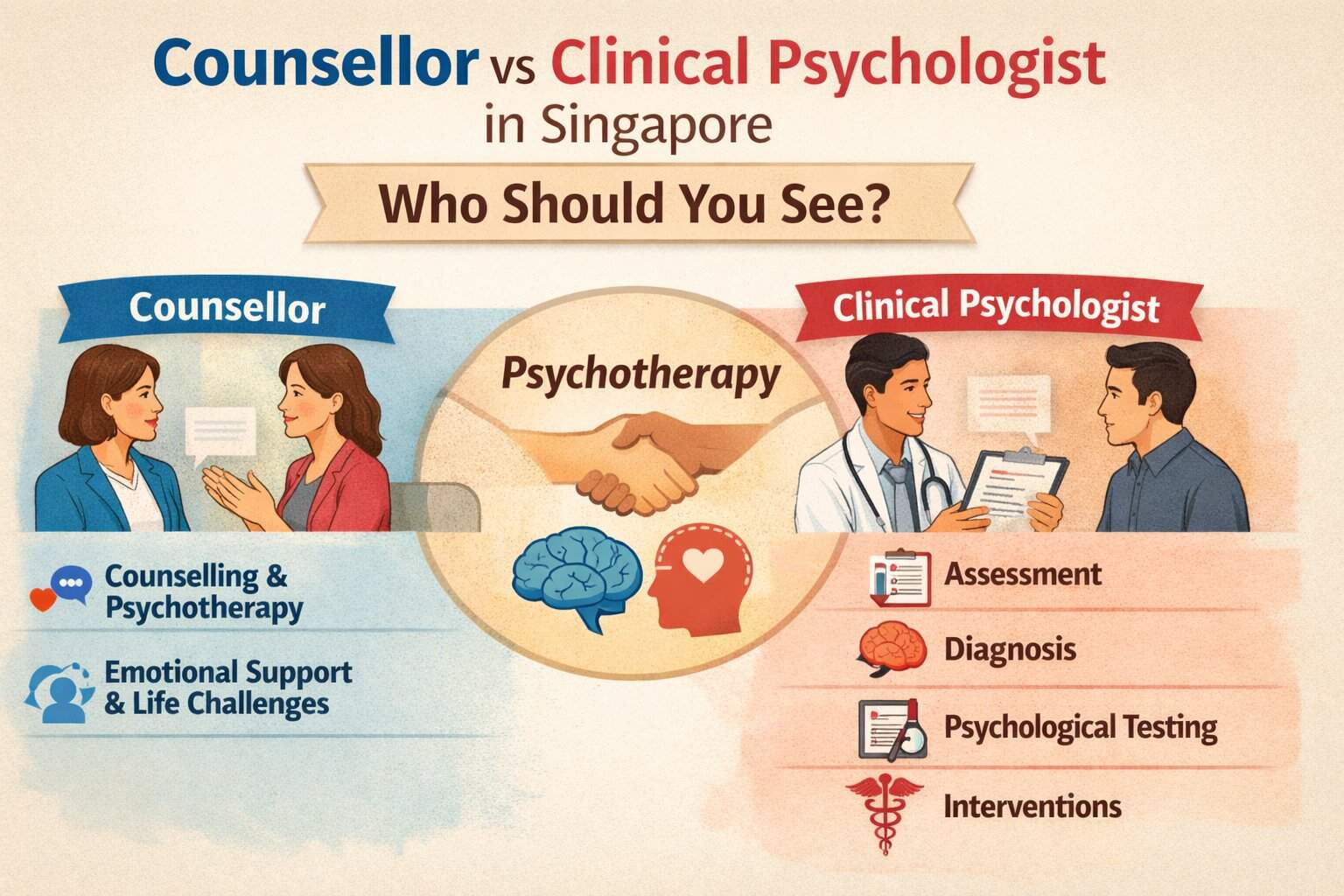
A counsellor focuses primarily on counselling and psychotherapy, supporting people through emotional distress, life challenges, and personal development.
A clinical psychologist focuses more broadly on psychological assessment, psychological testing, psychological diagnosis, and psychological interventions.
Both professions may provide psychotherapy, but their training emphasis and professional roles can differ.
What does a counsellor do?
Counsellors work with individuals who are experiencing emotional distress, psychological challenges, or difficulties in life. Their work centres on providing counselling and psychotherapy to help people better understand themselves, process their experiences, and develop healthier ways of coping.
Counsellors commonly support clients facing concerns such as:
-
anxiety and excessive worry
-
depression and low mood
-
stress and burnout
-
grief and loss
-
trauma
-
anger management
-
relationship difficulties
-
identity and self-esteem concerns
-
adjustment to life transitions
Counselling typically involves regular therapeutic conversations that help individuals explore their thoughts, emotions, and behavioural patterns in a safe and supportive environment.
In many counselling pathways, training is highly focused on counselling practice itself. Counsellors typically complete 100 practicum hours during postgraduate training, followed by 600 supervised counselling hours after graduation, resulting in approximately 700 counselling-focused hours.
Because these hours are dedicated specifically to counselling work, the training can be highly concentrated on developing counselling competence.
For many people experiencing emotional distress or life challenges, counselling is often the most appropriate starting point.
What does a clinical psychologist do?
Clinical psychologists are trained within the field of psychology and specialise in understanding, assessing, and treating mental health conditions from a psychological perspective.
Their work often includes:
-
psychological assessment
-
psychological testing
-
psychological diagnosis
-
psychological formulation
-
psychological interventions
Psychological assessment may involve structured interviews, cognitive testing, personality assessment, or behavioural evaluation. These assessments help clinicians understand how psychological difficulties develop and how they may be addressed.
Clinical psychologists may also provide structured psychological interventions, which are treatment approaches based on psychological theories and research.
While clinical psychologists may provide therapy sessions similar to counselling, their training often includes greater emphasis on assessment, diagnosis, and psychological testing.
The common ground: psychotherapy
Despite these differences, there is an important area of overlap.
Both counsellors and clinical psychologists may provide psychotherapy.
Psychotherapy refers to structured psychological treatment delivered through therapeutic conversations and psychological techniques. It aims to help individuals understand their patterns of thinking, feeling, and behaviour, while developing healthier ways of coping with challenges. The most common form of psychotherapy in Singapore is Cognitive Behaviour Therapy (CBT).
From a client’s perspective, psychotherapy sessions with a counsellor or clinical psychologist may sometimes look similar.
The main difference lies in training emphasis and professional scope, rather than whether both can provide therapeutic support.
Differences in training emphasis
Another difference between the two professions lies in how their training is structured.
The counselling pathway is typically centred on counselling practice itself. Training emphasises counselling theories, counselling skills, therapeutic relationship-building, and extensive counselling experience with clients.
Clinical psychology training, on the other hand, usually includes a broader scope that may involve:
-
psychological assessment
-
psychometric testing
-
diagnostic frameworks
-
research
-
clinical case formulation
-
psychological intervention planning
Because of this broader scope, practicum hours in clinical psychology programmes may include a mix of activities such as therapy sessions, assessment work, case documentation, case conferences, and supervision.
This means that although clinical psychologists may complete a larger total number of practicum hours, not all of those hours are purely counselling hours.
In comparison, the counselling pathway may involve more concentrated experience in providing counselling itself.
The important role counsellors play in Singapore’s mental health landscape
In Singapore, counsellors play an important role in supporting the mental health needs of the community.
Many people seeking help are not looking for psychological testing or diagnostic assessments. Instead, they are looking for a safe space to talk, process their experiences, and develop healthier ways of coping with life’s challenges.
This is the core space where counselling and psychotherapy are most relevant.
By focusing on counselling and psychotherapy, counsellors help fill an important gap in the mental health ecosystem. Their work allows individuals to access therapeutic support for concerns such as stress, anxiety, burnout, grief, relationship difficulties, and life transitions.
At the same time, clinical psychologists bring specialised expertise in areas such as psychological assessment, psychological testing, diagnosis, and structured psychological interventions.
When both professions operate within their strengths, they complement each other well.
Counsellors can focus on providing counselling and psychotherapy support to the community, while clinical psychologists can concentrate on areas where their training is particularly valuable, such as assessment, diagnosis, and specialised psychological evaluation.
Rather than viewing these professions as competing roles, it may be more helpful to see them as different parts of a broader mental health system, each contributing in their own way to supporting psychological wellbeing.
Which one should you see?
The more helpful question is usually not “Which profession is better?” but “What type of help do I need?”
You may consider seeing a counsellor if you are looking for:
-
counselling and psychotherapy support
-
help processing emotional distress
-
guidance through life challenges or transitions
-
support in understanding your thoughts, emotions, and behaviours
You may consider seeing a clinical psychologist if you need:
-
psychological assessment or testing
-
diagnostic evaluation
-
specialised psychological intervention for specific mental health conditions
For many individuals experiencing emotional distress or life challenges, seeing a counsellor is often a practical and accessible first step.
Final thoughts
Counsellors and clinical psychologists both play important roles in supporting mental health and wellbeing.
Clinical psychologists often focus on psychological assessment, testing, diagnosis, and psychological interventions, while counsellors focus more specifically on counselling and psychotherapy practice.
Both professions share an important common ground: psychotherapy.
For many people seeking help with emotional distress, anxiety, relationship difficulties, or life challenges, counselling can provide a valuable starting point for understanding themselves and working towards positive change.
To book a counselling session with The Lion Mind mental health clinician, visit https://www.thelionmind.com.sg/book-an-appointment
Related articles
Counsellor vs Counselling Psychologist in Singapore: What’s the Difference?

What is Cognitive Behaviour Therapy
If you like what you read, follow us on Facebook, Instagram, LinkedIn, or Tik Tok to get the latest updates.
Have a question? Reach out to us through our contact form or WhatsApp.
Want to speak to our clinicians? Book your appointment here!

Join Our Newsletter
Subscribe to our newsletter and receive daily updates & promotions!