


 0
0

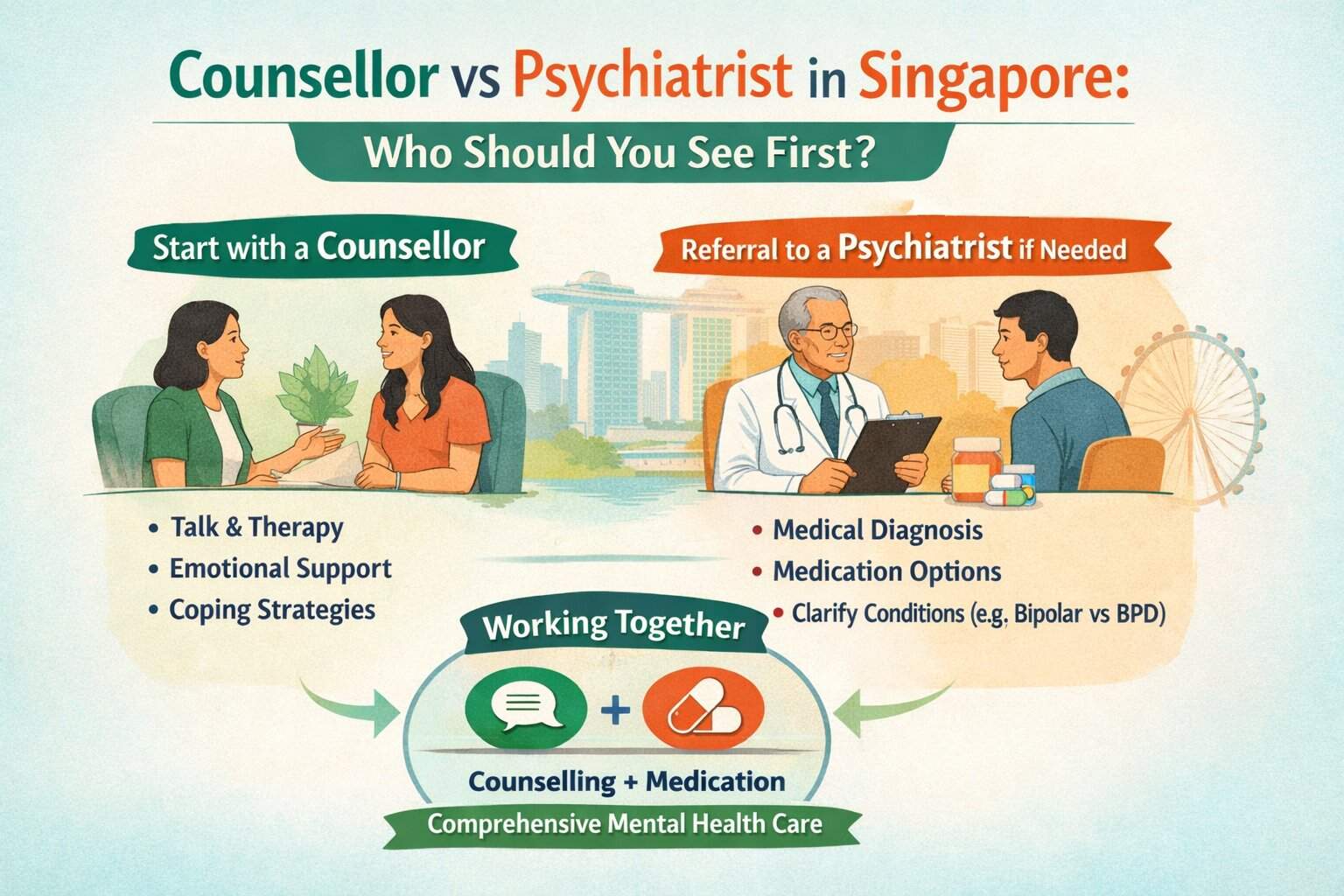
Counsellor vs Psychiatrist in Singapore: Who Should You See First?
Singapore
Mar 20 2026
When people begin looking for mental health support in Singapore, they often come across different professionals such as counsellors, clinical psychologists, and psychiatrists. These roles can feel confusing, especially when you are already dealing with stress, anxiety, or emotional difficulties.
One of the most common questions is: Should I see a counsellor or a psychiatrist first?
Both play important roles in mental health care, but they serve different functions. Understanding how they differ, and how they can work together, can help you make a clearer and more practical decision.
Quick answer
A counsellor focuses on counselling and psychotherapy, helping individuals work through emotional distress, life challenges, and personal difficulties.
A psychiatrist is a medical doctor who focuses on mental health diagnosis, medical treatment, and prescribing medication.
For many people, starting with a counsellor is often the most appropriate first step, with referral to a psychiatrist when needed.
What does a counsellor do?
Counsellors support individuals who are experiencing emotional distress, psychological challenges, or difficulties in life. Their work centres on counselling and psychotherapy.
Through therapy, counsellors help clients:
-
understand their thoughts, emotions, and behaviours
-
process difficult experiences
-
develop coping strategies
-
improve emotional regulation
-
work through relationship or life challenges
Counsellors commonly support concerns such as:
-
anxiety and excessive worry
-
depression and low mood
-
stress and burnout
-
grief and loss
-
trauma
-
anger management
-
relationship difficulties
-
identity and self-esteem issues
-
life transitions
Counselling provides a safe and structured space for individuals to talk, reflect, and work towards meaningful change.
For many individuals experiencing emotional distress or life challenges, counselling is often a practical and accessible starting point.
What does a psychiatrist do?
A psychiatrist is a medical doctor who specialises in mental health.
Their role focuses on:
-
diagnosing mental health conditions
-
prescribing medication
-
monitoring symptoms and treatment progress
-
managing more complex or severe psychiatric conditions
Psychiatrists are trained to assess mental health from a medical and diagnostic perspective, which allows them to identify specific clinical conditions and provide appropriate treatment.
The key difference: therapy vs diagnosis and medication
The main difference between a counsellor and a psychiatrist lies in their primary function.
A counsellor focuses on:
-
counselling
-
psychotherapy
-
emotional processing
-
behavioural and psychological change
A psychiatrist focuses on:
-
diagnosis
-
medication
-
medical management of symptoms
Both roles are important, but they address different aspects of mental health.
The role of psychiatrists in diagnostic clarity
One important role psychiatrists play is providing clear and timely diagnosis.
In some situations, different conditions may appear similar on the surface but require very different approaches. For example:
-
distinguishing Bipolar Disorder from Borderline Personality Disorder
-
differentiating clinical depression from situational distress
-
identifying underlying psychiatric conditions that may not be immediately obvious
From a counselling perspective, this diagnostic clarity can be very helpful.
It allows the counsellor to:
-
better understand the client’s condition
-
adjust the counselling approach appropriately
-
avoid using interventions that may not be suitable for the condition
Because psychiatrists are trained to assess and diagnose from a medical standpoint, they are often able to identify these distinctions more quickly, especially when symptoms are complex or severe.
The role and benefits of medication
Following a diagnosis, a psychiatrist may recommend medication where appropriate.
Medication can help to:
-
stabilise mood
-
reduce intensity of anxiety or depressive symptoms
-
improve sleep
-
support concentration and daily functioning
For individuals experiencing moderate to more severe symptoms, medication can provide enough stability for them to engage more effectively in therapy.
Medication is not a replacement for counselling, but rather a supporting tool that helps manage symptoms.
Why therapy and medication often work best together
For common mental health conditions such as anxiety and depression, research consistently shows that outcomes are often better when psychotherapy is combined with medication, compared to using either approach alone.
Medication works at a biological level to reduce symptoms, while counselling and psychotherapy address:
-
underlying thought patterns
-
emotional processing
-
behavioural habits
-
personal experiences and meaning
In simple terms:
-
medication helps stabilise
-
therapy helps transform
This combination is especially useful for moderate mental health concerns.
Starting with a counsellor: a practical approach
For many people, starting with a counsellor is a practical and effective first step.
A counsellor can:
-
provide immediate emotional support
-
help you make sense of your experiences
-
assess the nature and severity of your difficulties
-
guide you on next steps
Importantly, a counsellor can also identify when additional support is needed.
Closing the loop: how counsellors and psychiatrists work together
In practice, mental health care often works best as a collaborative process.
A common pathway looks like this:
-
You start with a counsellor
You explore your concerns, receive support, and begin therapy. -
Referral to a psychiatrist (if needed)
If there are signs that diagnosis or medication may be helpful, the counsellor may recommend seeing a psychiatrist. -
Psychiatric assessment and support
The psychiatrist provides diagnostic clarity and, where appropriate, medication. -
Return to counselling for ongoing therapy
With improved stability and clearer understanding, counselling continues to address deeper patterns and long-term change.
This creates a closed loop of care, where each professional contributes based on their strengths.
The role of counsellors in Singapore’s mental health landscape
In Singapore, counsellors play an important role in supporting the mental health needs of the community.
Many people seeking help are not looking for diagnosis or medication. They are looking for:
-
a safe space to talk
-
support in managing emotions
-
guidance through life challenges
This is where counselling and psychotherapy are most relevant.
By serving as the first point of contact, counsellors help individuals access support early, while also guiding them to additional services when necessary.
At the same time, psychiatrists provide essential expertise for diagnosis and medical treatment.
Together, they form a more complete and effective system of mental health care.
Which one should you see first?
The better question is not “Which is better?” but:
What kind of help do you need right now?
For many individuals, especially those experiencing emotional distress, anxiety, or life challenges:
👉 Starting with a counsellor is often the most appropriate first step
From there, additional support, including psychiatric care, can be introduced if needed.
Final thoughts
Counsellors and psychiatrists serve different but complementary roles.
-
Counsellors provide counselling and psychotherapy
-
Psychiatrists provide diagnosis, medication, and medical treatment
Rather than choosing one over the other, the most effective approach is often understanding how both can work together.
For many people, beginning with counselling allows for early support, clearer understanding, and guidance towards the most appropriate form of care, including referral when necessary.
Related articles
Counsellor vs Counselling Psychologist in Singapore: What’s the Difference?
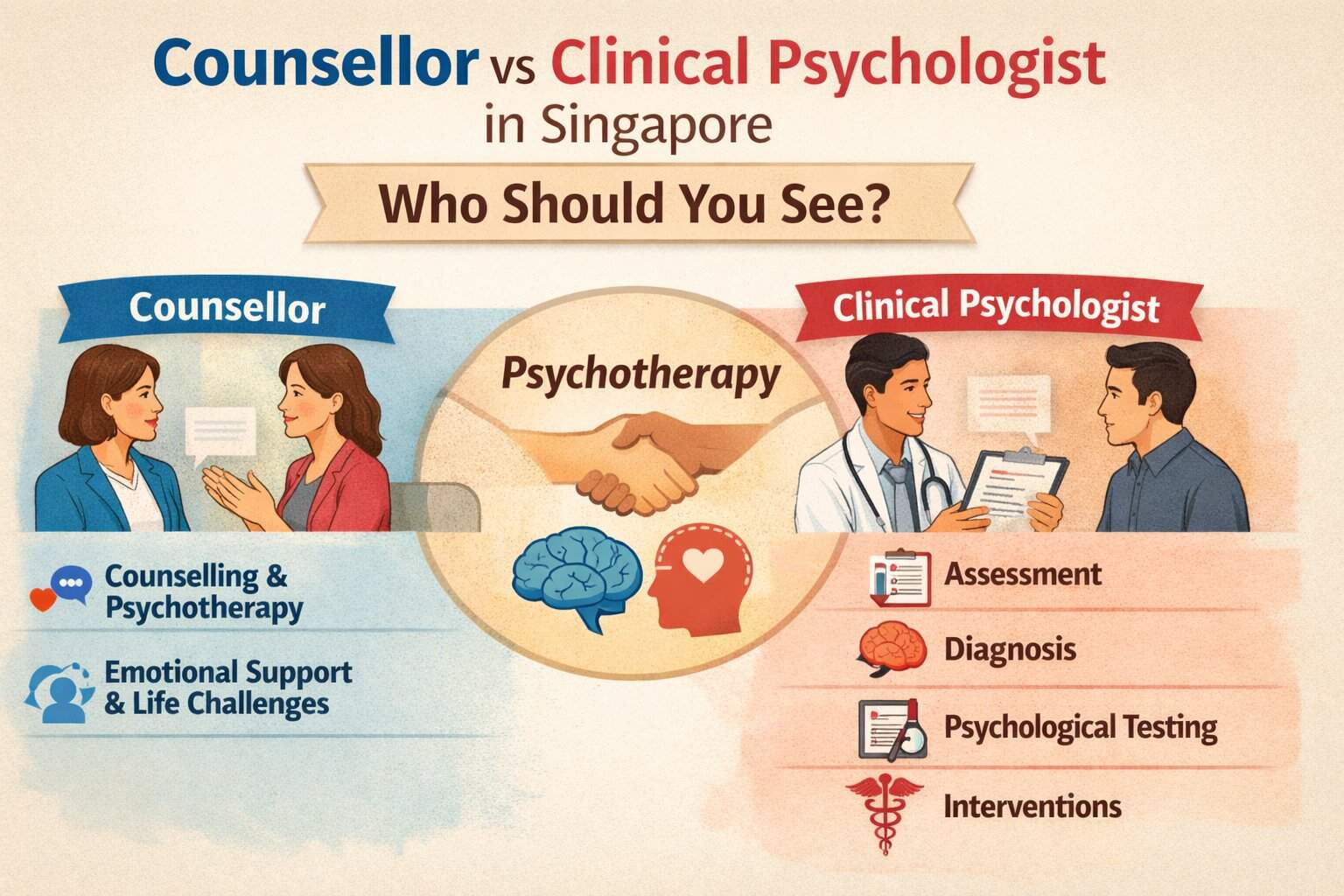
Counsellor vs Clinical Psychologist in Singapore: Who Should You See?
If you like what you read, follow us on Facebook, Instagram, LinkedIn, or Tik Tok to get the latest updates.
Have a question? Reach out to us through our contact form or WhatsApp.
Want to speak to our clinicians? Book your appointment here!

Join Our Newsletter
Subscribe to our newsletter and receive daily updates & promotions!