


 0
0

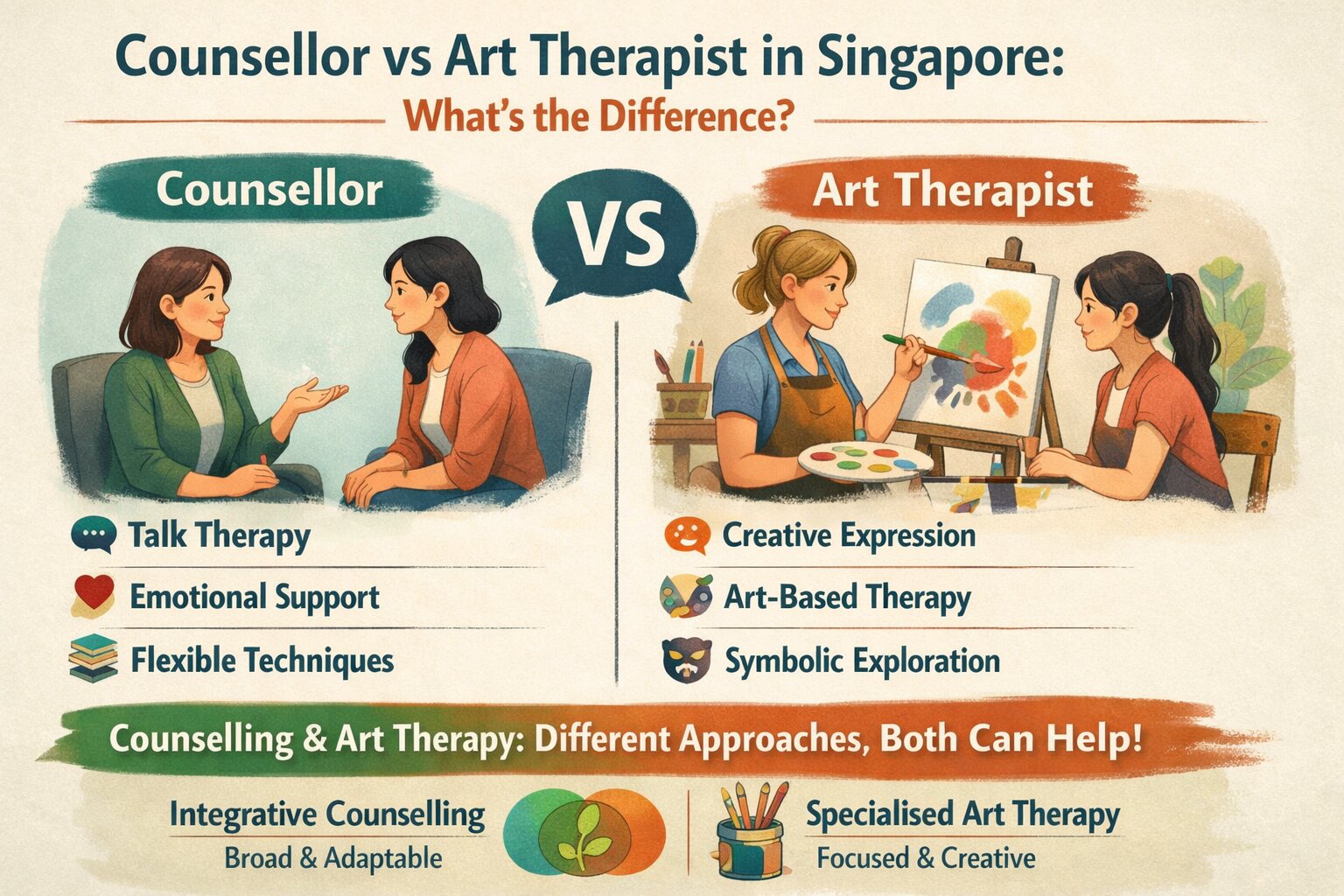
Counsellor vs Art Therapist in Singapore: What’s the Difference?
Singapore
Mar 26 2026
When exploring therapy options in Singapore, you may come across different types of mental health professionals such as counsellors and art therapists.
At first glance, both may seem similar. Both provide a safe space for individuals to explore their thoughts, emotions, and experiences. However, they differ in their training, methods, and areas of focus.
Understanding these differences can help you decide which type of support may be most suitable for your needs.
Quick answer
A counsellor provides counselling and psychotherapy, helping individuals process emotional experiences, develop coping strategies, and work towards meaningful change.
An art therapist is trained to use art as a primary therapeutic medium, helping individuals express and explore their inner experiences through creative processes.
Both can be effective, but they approach therapy in different ways.
What does a counsellor do?
Counsellors work with individuals experiencing emotional distress, psychological challenges, or difficulties in life.
Their work centres on counselling and psychotherapy, which involves:
- understanding thoughts, emotions, and behaviours
- processing life experiences
- developing coping strategies
- improving emotional regulation
- building insight and self-awareness
Counsellors commonly support concerns such as:
- anxiety and stress
- depression and low mood
- burnout
- trauma
- grief and loss
- relationship difficulties
- identity and self-esteem issues
Counselling typically takes place through therapeutic conversations, but it is not limited to talking alone.
What does an art therapist do?
Art therapists are trained to use art-making as a structured therapeutic process.
Rather than relying primarily on verbal expression, art therapy allows individuals to explore their inner experiences through:
- drawing
- painting
- collage
- other creative forms
This can be particularly helpful for individuals who:
- find it difficult to express themselves in words
- process emotions visually or symbolically
- benefit from non-verbal forms of expression
Art therapy is not about artistic skill or producing “good” artwork. Instead, it focuses on the process of creation and the meaning behind it.
The key difference: medium of therapy
The main difference between a counsellor and an art therapist lies in the primary medium of therapy.
A counsellor works mainly through:
- conversation
- reflection
- psychological exploration
An art therapist works mainly through:
- art-making
- visual expression
- symbolic processing
Both approaches can support emotional healing, but they engage clients in different ways.
The role of counsellors in integrative therapy
In practice, counselling is not limited to verbal conversation alone.
Many counsellors are trained in a range of therapeutic approaches, including experiential and expressive methods, and may incorporate these into their work where appropriate.
For example, a counsellor may use:
- imagery and metaphor
- projective tools such as cards
- creative or reflective exercises
- elements inspired by expressive modalities
This allows counselling to remain flexible and responsive to the client’s needs, rather than being limited to a single method.
At the same time, art therapists receive deeper, modality-specific training in the use of art as a therapeutic tool.
A balanced way to understand the difference is this:
- Art therapists offer depth within art-based therapy
- Counsellors offer breadth, integrating different approaches within a psychologically grounded therapy process
When might art therapy be helpful?
Art therapy may be particularly helpful when:
- you find it difficult to express emotions in words
- you prefer creative or non-verbal expression
- you are working through trauma or complex emotional experiences
- you benefit from visual or symbolic exploration
When might counselling be more suitable?
Counselling may be more suitable when you are looking for:
- a structured therapeutic conversation
- support in understanding thoughts and emotions
- guidance through life challenges or transitions
- development of coping strategies
- a flexible approach that can adapt to different needs
For many individuals, counselling provides a broad and adaptable foundation for therapy.
Can both approaches work together?
Yes.
Counselling and art therapy are not competing approaches. They can complement each other.
For example:
- A counsellor may incorporate expressive elements into sessions
- A client may engage in art therapy while also attending counselling
- Different approaches may be used at different stages of the therapeutic journey
The goal is not to choose one over the other, but to find the approach — or combination of approaches — that best supports the individual.
The role of counselling in Singapore’s mental health landscape
In Singapore, counsellors play an important role in providing accessible mental health support.
Many individuals seek help for:
- stress and burnout
- anxiety and low mood
- relationship challenges
- life transitions
These concerns may not require specialised modalities, but they benefit greatly from counselling and psychotherapy.
Because counselling is flexible and integrative, it can serve as a starting point for many individuals, while also incorporating or referring to other approaches when needed.
Which should you choose?
If you are unsure where to start:
👉 Starting with a counsellor is often a practical first step
From there:
- you can explore your concerns
- gain clarity on your needs
- be guided towards other approaches if appropriate
If you are specifically drawn to creative expression, art therapy may also be a valuable option.
Final thoughts
Counsellors and art therapists both support emotional and psychological wellbeing, but they do so through different approaches.
- Counsellors provide counselling and psychotherapy, with flexibility to integrate different methods
- Art therapists specialise in using art as a primary therapeutic medium
Rather than viewing them as competing options, it is more helpful to understand how they differ — and how they can work together.
For many individuals, counselling provides a strong foundation for therapy, while also allowing space to incorporate expressive and creative approaches where helpful.
Related articles
Counsellor vs Counselling Psychologist in Singapore: What’s the Difference?
Counsellor vs Clinical Psychologist in Singapore: Who Should You See?
If you like what you read, follow us on Facebook, Instagram, LinkedIn, or Tik Tok to get the latest updates.
Have a question? Reach out to us through our contact form or WhatsApp.
Want to speak to our clinicians? Book your appointment here!

Join Our Newsletter
Subscribe to our newsletter and receive daily updates & promotions!